
Primal Alexander Primer, Ep 01: Your Inner Sensei
Pictured: Morihei Ueshiba (Ōsensei): The founder of Aikido

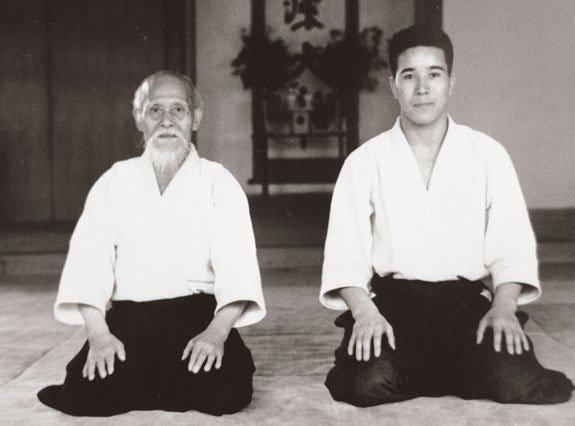
You know how in those martial arts movies, there's always that wise old sensei who shows up at just the right moment? The one who doesn't need to say much—maybe just a gentle touch or a quiet word—and suddenly the apprentice's whole world shifts, their breathing deepens, and they find that centered, grounded place they'd been struggling to reach?
Well, what if I told you that you already have a sensei like that living inside you? And what if I told you that this inner teacher doesn't speak in cryptic riddles or require years of meditation to access? Instead, it communicates through something so simple, so available, that most of us miss it entirely:
Ease!
Think about it. When you're really stressed—shoulders hunched, jaw clenched, holding your breath—what's the first thing that happens when someone you love walks into the room? Something softens, doesn't it? Maybe it's just your eyes that ease first, or perhaps your shoulders drop slightly. That softening? That's your inner sensei saying hello.
The thing is, we've been taught to pay attention to all the wrong things. We focus on our tension, our pain, our problems. We scan our bodies like detectives looking for evidence of what's wrong. "My neck is tight, my back hurts, my breathing is shallow." And while this might seem like useful information, it's actually keeping us stuck in the very patterns we're trying to change.
Your inner sensei—this wisdom of ease—works completely differently. Instead of focusing on what's wrong, it asks: "Where do I notice something that feels okay right now? Where am I already easing, even just a little bit?"
I call this Ima—Ima being the Japanese word for "now." It's astonishingly simple. Right now, as you're reading this, you could pause and ask: "Where else do I seem to be easing a bit?" Maybe it's your hands. Maybe it's your feet. Maybe it's some place you wouldn't expect, like the space around your heart or the back of your neck.
When you shift your attention to these places of relative ease, something neurologically magical happens. Your nervous system gets a different message. Instead of the alarm bells that go off when you focus on tension and problems, you're sending a signal that says, "Things are actually okay enough that I can notice comfort right now." This activates what researchers call your parasympathetic nervous system—your rest, digest, and heal response.
The beauty of your inner sensei is that it's always available. You don't need perfect conditions. You don't need to be pain-free. You just need to take a moment to be curious about ease, wherever it might be hiding in this moment.
I discovered this accidentally in my New York City apartment building playground, of all places. I was testing this idea with neighbors who knew nothing about the Alexander Technique or body work. I'd simply ask them to notice tension first, then shift their attention to anywhere that felt relatively easier. Within seconds—seconds!—you could see visible changes in how they carried themselves. Their posture improved, their breathing deepened, their whole presence shifted.
These weren't trained students or people expecting a certain result. They were just regular folks tapping into their inner sensei, that innate wisdom that knows how to coordinate and organize effortlessly when we give it the right kind of attention.
Your inner sensei doesn't bark commands like "Stand up straight!" or "Relax your shoulders!" It's much more subtle and effective than that. It whispers through sensations of ease, through moments when something feels just a little bit better, a little bit softer, a little bit more available.
The more you practice listening to this inner guidance, the stronger it becomes. It starts showing up not just when you're deliberately paying attention, but spontaneously more and more throughout your day. You'll find yourself naturally shifting toward ease, naturally finding better coordination, naturally discovering that centered, grounded quality that seemed so elusive before.
Ima is part of a suite of thought experiments I call CuriousThinking™, which form the backbone of my unique online approach to teaching the Alexander Technique called: Primal Alexander (P.A.)
In P.A., you learn how to approach change by summoning the gentle curiosity of a wise inner teacher. Instead of trying to force changes or fix what's wrong, you're simply noticing what's already working and allowing that to inform everything else.
Your inner sensei has been there all along, waiting patiently for you to shift your attention from problems to possibilities, from tension to ease, from struggle to curiosity. It doesn't require years of training or special credentials. It just requires a willingness to ask a different question: "Where else do I seem to be easing a bit?"
Trust me, once you start listening to this inner wisdom, you'll wonder how you ever got along without it.