
Primal Alexander Primer, Ep 08

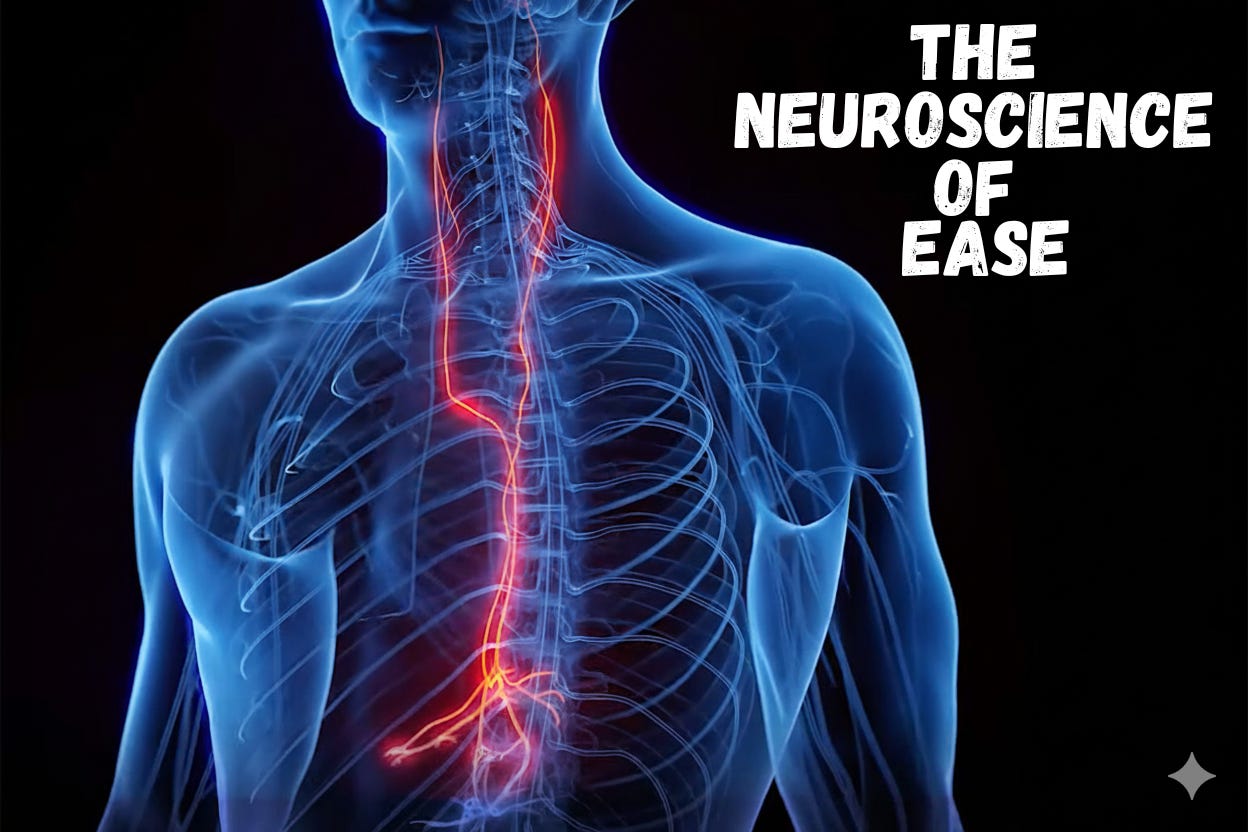
The ancient wisdom of martial arts masters and modern neuroscience converge on a remarkable truth: our nervous systems are exquisitely designed to respond to where we place our attention.
What mystics have long understood intuitively, contemporary research now reveals through the lens of neuroplasticity and autonomic nervous system function: There is an intricate dance between conscious awareness and physiological response.
The Survival-Based Architecture of Attention
The human brain evolved with a profound bias toward threat detection—a phenomenon neuroscientists call the “negativity bias.” This evolutionary programming supports survival by prioritizing potential dangers over pleasant experiences.
When we choose to focus on tension, pain, or problems in our bodies, we activate the sympathetic nervous system’s stress response, triggering a cascade of physiological changes designed for immediate action: increased heart rate, elevated cortisol levels, heightened muscle tension, and shallow breathing. This understanding explains why Primal Alexander’s methodology deliberately avoids the conventional diagnostic approach of scanning for what’s wrong.
Other research describes how our brains are “like Velcro for negative experiences and Teflon for positive ones,” creating neural pathways that reinforce patterns of tension and reactivity. When we habitually scan our bodies for problems—tight shoulders, aching backs, shallow breathing—we inadvertently strengthen these stress-response patterns at the neurological level.
The amygdala, our brain’s alarm system, interprets sustained attention to discomfort as evidence of ongoing threat. This interpretation maintains the body in a state of defensive readiness, characterized by increased muscular contraction, reduced parasympathetic activity, and diminished capacity for healing and repair.
The vagus nerve, on the other hand, our body’s primary relaxation pathway, interprets signals of safety and resolution as permission to restore equilibrium. This interpretation shifts the body into a state of recovery and renewal, characterized by decreased muscular tension, enhanced parasympathetic activity, and optimized capacity for healing and repair.
Enter: A Parasympathetic Pathway to Ease
It’s quick and it’s simple. It’s not meditation. You don’t have to sit on a cushion. You don’t have to close your eyes. You can do it anywhere, at any time, because all you’re doing is shifting your attention. It’s called Ima, the Japanese word for “now.”
Ima is a guided exploration that leverages the vagus nerve and the parasympathetic nervous system. When we consciously direct attention toward areas of relative comfort or ease, we stimulate the “social engagement system”—a network of neural pathways associated with safety, connection, and optimal physiological function.
Ima’s effectiveness lies in its ability to trigger activation of that nerve, which is the longest cranial nerve and the primary pathway of the parasympathetic nervous system. Vagal tone—the strength and responsiveness of this nerve—correlates directly with our capacity for emotional regulation, stress recovery, and physical coordination.
It’s been demonstrated that positive emotional states and focused attention on pleasant sensations measurably increase vagal tone, creating a physiological foundation for improved well-being, Use, and performance.
When we understand that simply asking students to notice ease—anywhere in their bodies—sends a profound signal to the nervous system. When we notice ease, the nervous system interprets this as evidence that conditions are safe enough to shift from survival mode to what researchers call “thrive mode.”
This interpretation triggers a cascade of beneficial changes: decreased cortisol production, increased oxytocin release, improved heart rate variability, and enhanced coordination between different body systems. The polyvagal theory explains how this attention shift allows for more sophisticated neural processing, moving from primitive brainstem responses to higher-order cortical integration.
This neurological shift creates the visible improvements in coordination and posture that Primal Alexander teachers can observe immediately—changes that occur without any hands-on intervention or effort to “correct” alignment.
Rewiring Through Attention Training and a Simple Question
TheCyCle™, the most well known of the attention training Études that characterize the Primal Alexander™ approach, features a 10 word phrase posed as a question: “Where Else Do I Seem to be Easing A Bit?”
The use of this phrase in training exemplifies how conscious attention can reshape our nervous system responses through neuroplasticity—the brain’s ability to reorganize and form new neural connections throughout life.
Research reveals that sustained attention practices literally rewire the default mode network, the brain’s background activity pattern that, because of the negativity bias, often perpetuates stress and rumination. However, TheCyCle’s repeated scanning for multiple areas of ease while engaging in movement creates what neuroscientists call “attentional training.”
When we repeatedly practice noticing ease, we strengthen neural pathways associated with interoceptive awareness—our ability to sense internal bodily signals. This enhanced interoceptive capacity allows for more nuanced discrimination between different bodily sensations, enabling us to detect the subtle gradations of ease that Primal Alexander methodology depends upon.
Mirror neuron research provides additional insight into how Primal Alexander’s attention-based approach creates observable changes in coordination and posture. When we internally attend to ease, mirror neuron networks activate corresponding patterns throughout the motor system, creating visible improvements in alignment and movement quality without conscious effort to “correct” or “adjust posture—a phenomenon that explains why Primal Alexander teachers can observe immediate changes in their students.
When we develop sensitivity to ease and comfort we enhance our ability to navigate complex situations with greater wisdom and efficiency. This integration of somatic awareness with cognitive processing represents a fundamental aspect of human intelligence that conventional education often overlooks—and that Primal Alexander’s approach specifically cultivates.
Embodied Cognition and Alexander’s Original Discovery Process
Primal Alexander’s methodology draws profound validation from contemporary research in embodied cognition, which reveals that our thinking processes are fundamentally shaped by our bodily states. When we cultivate awareness of ease, we’re not simply changing how we feel—we’re altering the neurological foundation of cognition itself.
This principle aligns perfectly with Alexander’s original discovery process, which Primal Alexander honors by teaching students to develop their own sensory awareness rather than depending on external guidance.
The neuroscience supporting Primal Alexander’s approach has profound implications for how we understand learning, development, and therapeutic intervention.
Traditional approaches that emphasize problem identification and correction may inadvertently reinforce the very patterns they seek to change by maintaining activation of stress-response systems.
In contrast, Primal Alexander’s approach, which cultivates awareness of what’s already working—areas of ease, comfort, and natural coordination—supports the neuroplastic changes necessary for genuine positive transformation.
©2025 Mio Morales. All Rights Reserved.