
The Power of Ease™ Part 1

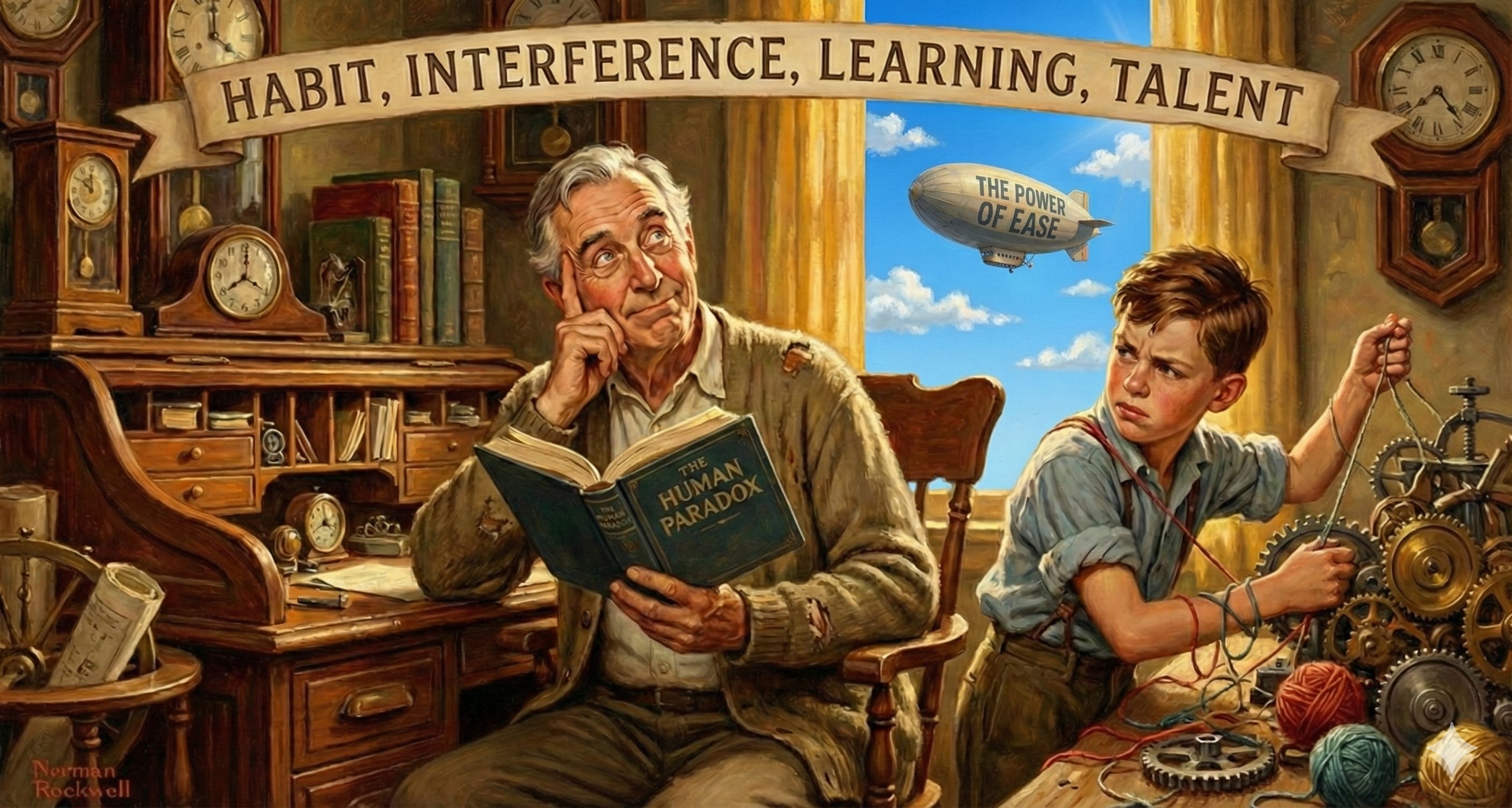
Every human being is caught in a profound paradox: the very mechanisms that enable us to function efficiently in a complex world are the same mechanisms that ultimately limit our potential. This paradox lives in the intricate relationship between habit, interference, learning, and what we commonly call talent. Understanding these relationships doesn’t just illuminate how we develop skills—it fundamentally challenges our assumptions about human capacity and reveals why trying harder often makes things worse.
Habits: The Necessary Assumptions
Habits are psychophysical assumptions—neurological shortcuts that our nervous system creates to navigate the world without overwhelming our conscious attention. Every time you walk, speak, pick up a cup, or respond to a familiar situation, you’re running on habits. These patterns are grooved into your brain through consistent repetition, creating neural pathways that fire automatically without requiring conscious thought.
This automation is absolutely necessary for survival. Imagine if you had to consciously control every aspect of walking—the precise angle of each ankle, the timing of each muscle contraction, the shifting of weight from heel to toe. You’d never make it across the room. Your nervous system evolved to automate frequent patterns precisely so your conscious attention could focus on novel challenges and threats. Habits free up cognitive bandwidth for what matters.
But here’s the critical insight that most people miss: habits are formed by making consistent choices, which then groove their way into your brain. The nervous system doesn’t distinguish between useful and harmful patterns when creating these grooves. It simply automates whatever you practice most consistently. If you habitually tense your shoulders when concentrating, that tension becomes part of your habitual response to any challenging mental task. If you habitually hold your breath when anxious, breath-holding becomes automatically linked to situations that trigger anxiety.
The formation of habits relies on neuroplasticity—the brain’s capacity to rewire itself based on experience. Every time you repeat a pattern of thought, movement, or response, you’re strengthening the neural pathways associated with that pattern. This is why practices work: the repetition literally changes your brain structure. But it’s also why bad habits become so entrenched. You’ve been practicing them, often unconsciously, for years or even decades.
What makes habits particularly insidious is that they operate below the threshold of awareness. By definition, a habit is something you do without thinking about it. You can’t simply decide to stop a habit through willpower because the pattern activates before conscious choice enters the picture. Your nervous system has learned that this particular response “works” in this context, so it fires automatically. The habit feels normal, natural, like “just how things are” rather than a choice you’re making.