
What if Alexander got it wrong!

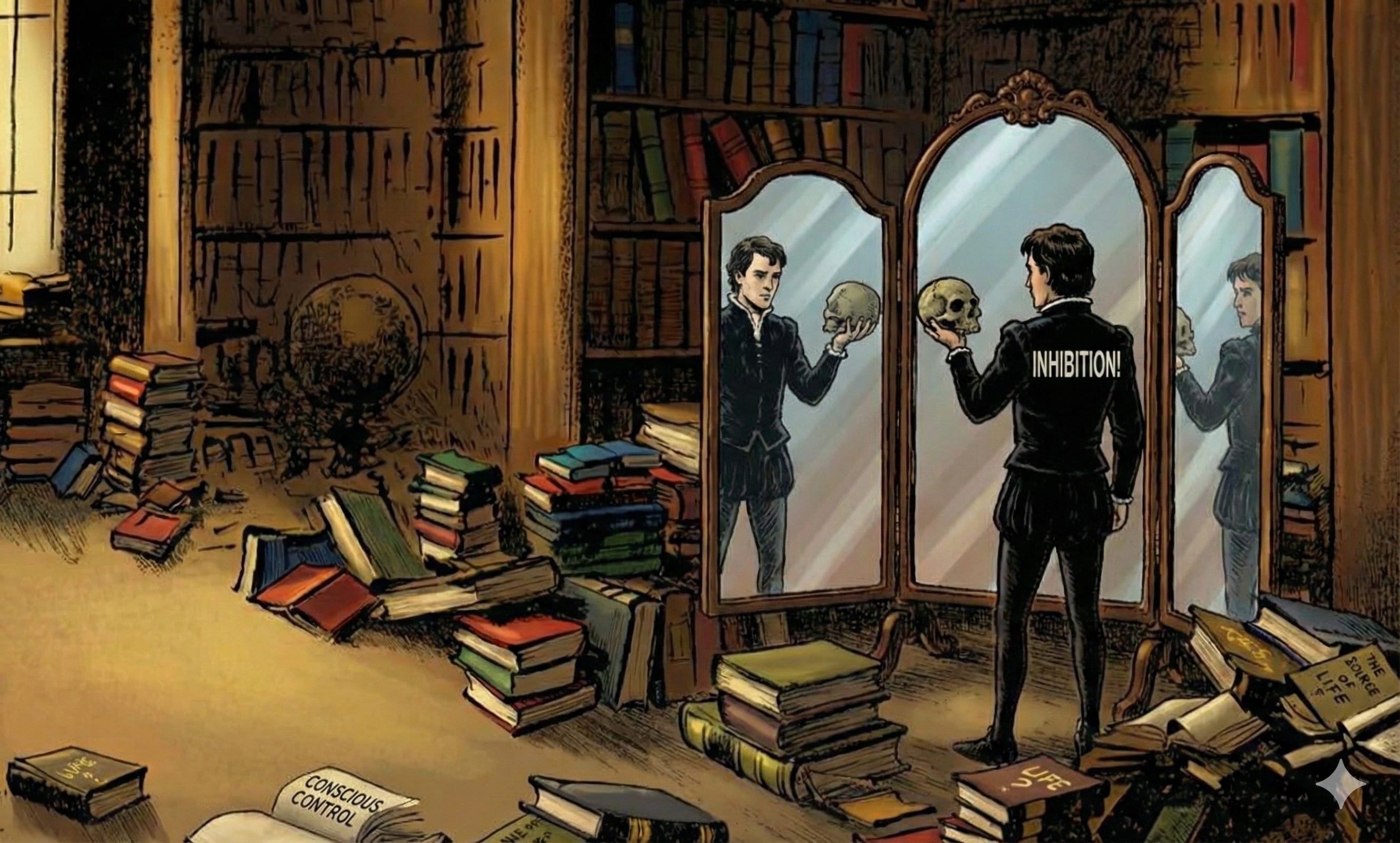
Okay, not wrong wrong. But what if the man who literally invented one of the most powerful tools for change in human history actually solved his problem by doing something way simpler than “ Constructively & Consciously Controlling the Individual”?
Stay with me here.
The mirror that ruined everything
(in the best possible way)
So picture this: Young F.M. Alexander the actor WAY down under in Tasmania in the late 1800s. He keeps losing his voice on stage. Voice teachers can’t help him. Doctors can’t help him. Elocution experts can’t help him. So he does what any obsessive, slightly unhinged genius with a ton of free time on his hands would do.
He parks himself in front of three mirrors for years and watches himself speak.
And what he sees is crushingly disappointing!
He’s doing the exact opposite of what he thinks he’s doing. He feels himself putting his head “forward and up.”, but he sees himself pulling his head back and down. Every. Single. Time.
His own body is gaslighting him.
His nervous system had gotten so used to doing the wrong thing that the wrong thing feels totally right — like how you don’t notice a crooked picture frame on your wall until someone points it out, and then you can’t unsee it.
Except it’s your entire body. And your voice. And you’re an actor whose career depends on it.
So what did he actually do about it?
The standard story goes something like: he figured out how to consciously direct his body, wrote a bunch of books including one literally called Constructive Conscious Control of the Individual, and voilà — conscious control saves the day.
But when you read between the lines of his account in Evolution of a Technique, I’m not sure that it was conscious CONTROL of the individual that came his rescue…
I think it was simpler than that…
What he did, for years, was stand in front of those mirrors and practice...
NOT CONTROLLING things.
That’s it. That’s the revolution!
He’d get the urge to speak. And instead of speaking, he’d just...
NOT!
He’d sit in that strange gap between wanting to do the thing and doing the thing. He called it “inhibition” —way before Freud, and it would prevent him from the habitual, knee-jerk, autopilotreaction that was killing his voice.
He wasn’t learning a new way to move as much as he was UNLEARNING the old way a new way was arising.
And here’s the kicker — in his writing, when he used phrases like “instinctive response,” he wasn’t talking about actual instincts. He was talking about psycho-physical habits so automatic and deeply grooved into his nervous system that they seemed instinctive. Like reaching for your phone when you’re bored. It feels like breathing. It’s not. It’s just what you’ve practiced about a million times.
The gap is where the magic happens
Think of it like this.
That gap — that tiny pause before you react — Alexander turned that into a new way of looking at helping yourself.
He’d decide to speak, then choose not to. Or he’d decide to speak, then do something else entirely. Over and over and over, for what he described as “a considerable time” (which, in Edwardian-speak, probably means years)
And slowly — not overnight, not in a weekend workshop, not in one big “aha” moment — his nervous system started to recalibrate “no” by “no” by little “no”.
The gap wasn’t just a pause. It was a habit-free zone where his nervous system and body could finally rebuild fresh responses without the old blueprints getting in the way.
What actually fixed his voice
Here’s what Alexander himself wrote: “Once free from this tendency, I also became free from the throat and vocal trouble and from the respiratory and nasal difficulties with which I had been beset from birth.”
Read that again. From birth.
He didn’t fix his voice by learning how to use it better. He fixed it by stopping the interference that had been mucking it up his whole life. His body already knew what to do. It just couldn’t, because decades of habits jumping in front and getting in the way.
That’s one of the ideas behind Primal Alexander™
We call it CuriousThinking™. And honestly, the simplicity of it is almost annoying.
You pause. You get curious about where you notice a bit of relative ease in your body. And then — here’s the cool part — as you start doing whatever you were about to do, you just decide to stay curious as long as you can and pay attention to what’s happening to that ease as you move.
It’s absolutely NOT about MAINTAINING the ease!
The simple act of deciding to be curious about ease keeps the gap open and keeps the flow of easier movement going.
We’re just acting like a scientists objectively watching an experiment unfold that allows your body and nervous system adapt naturally to the demands of what your movement requires and you end up moving and an easier more efficient way.
Inevitably, we do get distracted and we stop being curious about the ease without realizing it. But, as soon as we do realize it, we can decide to notice a place of relative ease again and the process begins again.
It’s not about trying to control what happens. It’s about being curious about what’s actually in the process of happening.
While the gap is open, we have access to what we call IndirectDirection™ — which is basically allowing the built-in, intrinsic movement intelligence that underlies even our most limiting habits…
It let’s that smart part of our neurology have a much greater influence on the manner in which we use ourselves which leads to an experience of movement that is much easier and also way more effective.
The funny thing nobody tells you about change
It’s both fast and slow…
It always happens immediately but it sure does takes it’s time!
Alexander didn’t stand in front of his mirrors for a long weekend and emerge like a butterfly. He did it for years. And that tracks with everything we now know about how nervous systems actually change — through repetition, through consistency, through doing the simple thing again and again until it becomes the new default.
In other words…
IT TAKES PRACTICE!
In Primal Alexander™ that’s what the études do. They are really simple, mostly uninteresting little movements that allow you to focus on the process of inhibition and it’s power. It’s the repetition and simplicity of deciding to prioritize paying attention to the process of change rather than the results it produces…
And is that decision that exposes and defeats end-gaining which leads to the rewiring of our nervous system and the improves]ment of our Use.
So, what’s the actual takeaway here?
Look — Alexander wrote a whole book about conscious control. It’s right there in the title. And I’m not saying he was wrong.
But, I think when you look at what he actually did, day after day in front of those mirrors, it looks a lot less like control and a lot more like... getting out of his own way.
He created a gap. He lived in that gap. And in that gap, his body remembered and acted upon what it already knew how to do.
Which, if you think about it, is way easier than constantly trying to constructively & consciously control one’s individuality.
It means the thing you’re looking for — that ease, that natural coordination, that freedom — isn’t something you need to build from scratch.
It’s already there.
We just have to stop burying it.
Cheers,
Mio
My second Alexander teacher Magdalena P said you were good, and we always looked for the GAP and found the ease that inhibiting the habit yielded. Naturally this allowed “forward and up etc. “ to consolidate easier, less effortful motion in action.